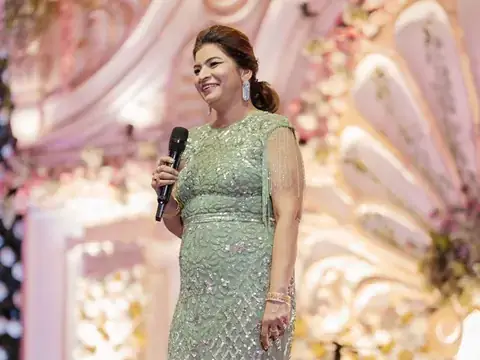
By Anu Manocha, anchor & emcee in Delhi
Last updated:
An anchoring script (also called a compering script) is the anchor's guide for the whole event: who comes on stage, in what order, and the exact lines that link each part. A good script has an opening, a welcome, introductions, short transitions and a closing, and leaves room for delays.

What goes into an anchoring script?
Most events follow the same order. Fill in names and timings, and you have the backbone of your script.
| Part | What the anchor does | Typical time |
|---|---|---|
| Opening | Greets the audience, sets the mood, says what the event is about | 1–2 min |
| Welcome | Welcomes the chief guest and dignitaries by name and designation | 2–3 min |
| Lamp lighting / invocation | Invites guests to the stage for the lamp or a prayer | 3–5 min |
| Speeches | Introduces each speaker and thanks them after | 30 sec per link |
| Performances / sessions | Links each item with one or two lines | 30 sec per link |
| Awards / felicitation | Reads names, calls presenters, keeps the line moving | as planned |
| Vote of thanks | Invites the person giving thanks, or gives it | 2–3 min |
| Closing | Thanks everyone, shares next steps (dinner, photos, exit) | 1 min |
For event-specific versions, see the sangeet anchoring script and the annual day anchoring script. For the opening and the send-off, see the welcome speech for anchoring and these farewell speech samples.
Sample anchoring script lines in English
Use these as a starting point. Change the names, the occasion and the tone to suit your audience.
Starting lines for anchoring
The first 30 seconds set the tone. Pick the opening that suits your event.
Good evening, ladies and gentlemen. A very warm welcome to [event name]. Tonight is about [purpose of the event], and we have a lovely evening planned for you. Please take your seats, put your phones on silent, and let's begin.
Good morning, respected chief guest, distinguished guests and friends. On behalf of [organisation], I welcome you all to [event name]. Thank you for being here with us today.
Good evening, everyone! Tonight we are here to celebrate [name / occasion], so let's fill this room with smiles and get started.
Linking lines for guests, speakers and awards
It is our honour to welcome our chief guest for the evening, [name], [designation]. [One line about their work.] Please join me in a big round of applause.
We begin, as always, by lighting the lamp. May I request [chief guest], [guest of honour] and [host's name] to kindly come to the stage.
Our next speaker has spent [number] years in [field] and is known for [one fact]. To share their thoughts on [topic], please welcome [name].
Thank you, [name], for those words. One line to remember from that talk: [short point]. Let's thank them once again.
And now, something to lift the energy. Please put your hands together for [performer / group] with [item].
The next award is for [category]. To present it, may I invite [presenter]. And the award goes to… [winner]!
Before we close, I invite [name] to share the vote of thanks.
That brings us to the end of today's programme. Thank you for being such a wonderful audience. Dinner is served at [place]. Please stay for photographs, and have a safe journey home.
Sample anchoring lines in Hindi
For a Hindi or mixed audience, these lines keep the tone warm and simple.
नमस्कार और आप सभी का हार्दिक स्वागत है। आज की यह शाम [अवसर] के नाम है। आप अपनी जगह ले लीजिए, फ़ोन साइलेंट पर कर दीजिए, और चलिए शुरू करते हैं।
आज हमारे बीच मुख्य अतिथि के रूप में उपस्थित हैं [नाम], [पद]। ज़ोरदार तालियों के साथ इनका स्वागत कीजिए।
तालियाँ बजती रहें, क्योंकि अब बारी है [प्रस्तुति] की। मंच पर स्वागत है [नाम] का।
आप सभी का दिल से धन्यवाद। आपकी मौजूदगी ने इस कार्यक्रम को ख़ास बना दिया। भोजन [स्थान] पर है। फिर मिलेंगे।
How do you write your own anchoring script?
- Get the run-of-show first. Ask the organiser for the final order, timings and names.
- Check every name and designation. Ask how names are pronounced. A wrong designation is the mistake guests remember.
- Write one short link per item. Two or three lines are enough. The stage belongs to the speakers.
- Keep links under 30 seconds. Long links make the event drag.
- Plan fillers. Keep a quiz question, a short story or an audience shout-out ready for when a speaker is late.
- Walk through it with the sound team. Mark music, mic and light cues next to each line.
What should you avoid in an anchoring script?
- Reading every word from paper. Use cue cards and look at the audience.
- Jokes about guests, religion or looks. Keep humour light and safe.
- Long quotes and shayari after every item. One or two at the right moment work better.
- Guessing names. If you are not sure, ask before the event.
A ready-to-fill script template
Copy this table into a document and fill one row per item. On a phone, swipe the table sideways.
| Time | Item | On stage | Anchor line | Cue |
|---|---|---|---|---|
| 6:00 | Opening | Anchor | Welcome line | Mic on, intro music |
| 6:03 | Welcome | Chief guest | Name + designation | Spotlight |
| 6:06 | Lamp lighting | Guests | Invitation line | Instrumental music |
| … | … | … | … | … |
Want someone else to hold the mic? Anu works as a corporate event anchor in Delhi and plans the script with you.
Frequently asked questions
How long should an anchoring script be?
It depends on the event, but each link should be short: two or three lines, under 30 seconds. A two-hour programme usually needs a script of four to six pages, including names, timings and cues for the sound team.
Should an anchor memorise the script?
No. Learn the opening, the welcome and the closing by heart, and keep cue cards for the rest. Names, designations and award lists should always be read from the card, because they must be exactly right.
What is the difference between anchoring and compering?
There is no real difference. Both words mean hosting a programme and linking its parts. "Compering" is more common in British and Indian school use, and "anchoring" or "emceeing" in events and media.
Can I get an anchoring script prepared for my event?
When Anu hosts your event, she helps develop the script with you and aligns it with your running order, in English, Hindi or Punjabi. Please share the running order at least 7 days before the event. Send your date and details on WhatsApp to check availability.